Poem of the Day

An excerpt from the poem Endymion by John Keats:

A thing of beauty is a joy for ever:

Its loveliness increases; it will never

Pass into nothingness; but still will keep

A bower quiet for us, and a sleep

Full of sweet dreams, and health, and quiet breathing.

Therefore, on every morrow, are we wreathing

A flowery band to bind us to the earth,

Spite of despondence, of the inhuman dearth

Of noble natures, of the gloomy days,

Of all the unhealthy and o’er-darkened ways

Made for our searching: yes, in spite of all,

Some shape of beauty moves away the pall

From our dark spirits. Such the sun, the moon,

Trees old and young, sprouting a shady boon

For simple sheep; and such are daffodils

With the green world they live in; and clear rills

That for themselves a cooling covert make

‘Gainst the hot season; the mid forest brake,

Rich with a sprinkling of fair musk-rose blooms:

And such too is the grandeur of the dooms

We have imagined for the mighty dead;

All lovely tales that we have heard or read:

An endless fountain of immortal drink,

Pouring unto us from the heaven’s brink.

       Nor do we merely feel these essences

For one short hour; no, even as the trees

That whisper round a temple become soon

Dear as the temple’s self, so does the moon,

The passion poesy, glories infinite,

Haunt us till they become a cheering light

Unto our souls, and bound to us so fast,

That, whether there be shine, or gloom o’ercast;

They always must be with us, or we die.

       Therefore, ’tis with full happiness that I

Will trace the story of Endymion.

The very music of the name has gone

Into my being, and each pleasant scene

Is growing fresh before me as the green

Of our own valleys: so I will begin

Now while I cannot hear the city’s din;

Now while the early budders are just new,

And run in mazes of the youngest hue

About old forests; while the willow trails

Its delicate amber; and the dairy pails

Bring home increase of milk. And, as the year

Grows lush in juicy stalks, I’ll smoothly steer

My little boat, for many quiet hours,

With streams that deepen freshly into bowers.

Many and many a verse I hope to write,

Before the daisies, vermeil rimm’d and white,

Hide in deep herbage; and ere yet the bees

Hum about globes of clover and sweet peas,

I must be near the middle of my story.

O may no wintry season, bare and hoary,

See it half finish’d: but let Autumn bold,

With universal tinge of sober gold,

Be all about me when I make an end.

And now, at once adventuresome, I send

My herald thought into a wilderness:

There let its trumpet blow, and quickly dress

My uncertain path with green, that I may speed

Easily onward, thorough flowers and weed.

Happy Birthday E.E. Cummings

To celebrate this great American writer, I’m sharing one of my favorite poems of his.

We should regularly revisit and share the works of writers who have woven our cultural fabric, before the woke mob cancels them!

Edward Estlin Cummings born in Cambridge, Massachusetts on October 14th, 1894

i carry your heart with me

i carry your heart with me (i carry it in
my heart) i am never without it (anywhere
i go you go, my dear; and whatever is done
by only me is your doing, my darling)
                                  i fear
no fate (for you are my fate, my sweet) i want
no world (for beautiful you are my world, my true)
and it’s you are whatever a moon has always meant
and whatever a sun will always sing is you

here is the deepest secret nobody knows
(here is the root of the root and the bud of the bud
and the sky of the sky of a tree called life; which grows
higher than soul can hope or mind can hide)
and this is the wonder that’s keeping the stars apart

i carry your heart (i carry it in my heart)

Quote of the Day

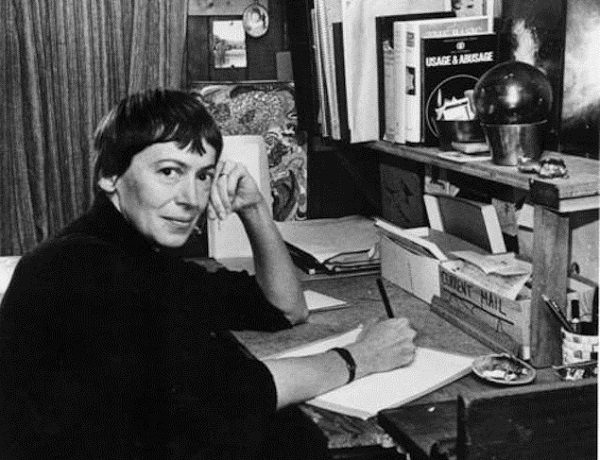
“I think hard times are coming when we will be wanting the voices of writers who can see alternatives to how we live now and can see through our fear-stricken society and its obsessive technologies. We will need writers who can remember freedom. Poets, visionaries – the realists of a larger reality.”

URSULA K. LE GUIN
Visionnaire and writer extraordinaire: Ursula K. Le Guin

Cancelling the Classics? The Woke Crowd Comes for Homer’s “Odyssey”

By Matthew Pheneger

The “woke” crowd is now intent on tossing out Homer’s “Odyssey” and challenging classical literary tradition. They want to inculcate a Jacobin uniformity of belief in the minds of future generations. How much easier will it be to recast history in the rigid terms of oppressor and oppressed, of exploiter and exploited, when no one has the intellectual wherewithal to understand history in all of its facets and contours?

The featured image is “Odysseus and Polyphemus” (1896) by Arnold Böcklin (1827–1901) and is in the public domain, courtesy of Wikimedia Commons.

For well over a century, Homer’s Odyssey has been a mainstay of American high school education. Indeed, although it is common to allow educators a significant degree of independence with regards to which books they choose to include in their curriculum, the Odyssey occupies an almost hallowed place in American cultural life, symbolizing as it does the value of the quest, or journey, and the realization of the goal to which it leads. As an op-ed published in the Wall Street Journal this past December makes alarmingly clear however, the burgeoning “cancel-culture” or “woke” crowd is not content to merely silence the voices of the living. Now, they have set their sights on Homer and the classical literary tradition.

The article, authored by the essayist Meghan Cox Gurdon and entitled “Even Homer Gets Mobbed,” details a recent Twitter exchange in which a high school English teacher implored her followers to “Be like Odysseus and take the long haul to liberation, and then take the Odyssey out of your curriculum because it’s trash.” In response to the latter, a second teacher, employed at a public high school in Massachusetts, declared: “Hahaha. Very proud to say we got the Odyssey removed from the curriculum this year.”

Far from an isolated incident, Ms. Gurdon is keen to point out that this exchange reflects the most recent examples of a “sustained effort” to deny young people the pleasure of engaging with the literary treasures of the past. As one critic bluntly put the matter in an edition of the School Library Journal published this past June: “Challenging old classics is the literary equivalent of replacing statues of racist figures.” In addition to Homer, Ms. Gurdon suggests that authors ranging from Shakespeare to Nathaniel Hawthorne are seemingly at risk of being consigned to the rubbish bin of history.

In place of the classics, those hankering for their disposal appear to be advocating for a more “inclusive” curriculum consisting largely of young adult fiction and socio-political tracts that expound on various hot-button political themes. While there is certainly nothing wrong with teaching such works, the Twitter conversation Ms. Gurdon describes makes it clear that simply diversifying the curriculum isn’t the motivation here. Rather, it is to reduce the “subtle complexities of literature” to the “crude clanking of ‘intersectional’ power struggles.”

Indeed, as those of us who read dystopian novels such as Aldous Huxley’s Brave New World or George Orwell’s 1984 should recognize, power is the bottom line. To those who want to dispense with it, the emphasis that the principal works of the Western Canon have historically enjoyed is not a reflection of the intrinsic worth of the texts themselves, but of who wields the most power in society. Pursuing this Machiavellian logic through to its conclusion, it follows that if those who are critical of “old classics” can successfully disparage them in the public arena, the amount of power they possess will increase relative to those who allegedly have an interest in the perpetuation of such works.

But the degree of wisdom that a society has attained is not a question of power. Rather, we ought to consider its capacity for wrestling with nuance and complexity. Tempting as it may be to view the world through the black and white lens of “us vs. them” or “good and evil,” reality invariably proves itself to be one or more shades of grey. Homer’s poetry is a testament to this enduring truth. Consider, for example, the Iliad, which recounts the story of the Trojan War. The final scene of that epic is famous, not for a hair-raising depiction of combat between the Greeks and the Trojans, or of one side triumphing over the other, but for the fleeting moment of compassion in which the Greek hero Achilles finally lets go of his overbearing wrath and turns the body of Hector over to Priam, the aged Trojan King. Thus Homer shows us that even in the midst of the most protracted and bitter conflicts, humanity’s capacity for love and mutual understanding prevails over its baser instincts, at least momentarily.

Those intent on tossing out the classics don’t want nuance however. They want to inculcate a Jacobin uniformity of belief in the minds of future generations. How much easier will it be to recast history in the rigid terms of oppressor and oppressed, of exploiter and exploited, when no one has the intellectual wherewithal to understand history in all of its facets and contours? How much easier to keep society polarized when its members lack common cultural reference points or a willingness to engage with perspectives that clash with their own?

Though all indicators suggest that the assault on the classics will only continue to gain traction as the culture war drags on, such efforts may ironically do these time-honored texts a great service. As history attests, attempting to suppress something or construe it as “forbidden fruit” more often than not only serves to make the object of derision that much more alluring to those who are kept from it. That aspect of human nature at least is not so easy to re-program. Given the overwhelmingly positive response that Ms. Gurdon’s article has received, this appears to be no less true where Homer is concerned. As a simple Google search reveals, at least ten articles have already surfaced coming to Homer’s defense against these most recent ideological attacks.

Indeed, although Homer was traditionally said to have been a blind poet, his vision was seemingly prophetic when he composed these immortal lines:

Yea, and if some god shall wreck me in the wine-dark deep,
even so I will endure…
For already have I suffered full much,
and much have I toiled in perils of waves and war.
Let this be added to the tale of those.

SOURCE: https://theimaginativeconservative.org/2021/01/cancelling-classics-woke-crowd-comes-homer-odyssey-matthew-pheneger.html

“You’re gonna make it after all”

There’s nothing quite as cheerful as the opening theme to The Mary Tyler Moore Show:

Watching this and listening to the music makes me so nostalgic for a time when we were more innocent. However that refrain, “you’re gonna make it after all,” reassures us, after all these years, that there are still brighter days ahead.

LIFE IS SMART

The attribute of life is what makes something smart. And yet, so many lifeless concepts and gadgets are given the name “smart.”

“Smart” might be the biggest marketing scam of our time.

Design Technology specialist and Biomimicry pioneer Prashant Dhawan ponders the validity of the “Smart City” in the video below:

Are Smart Cities Smart?

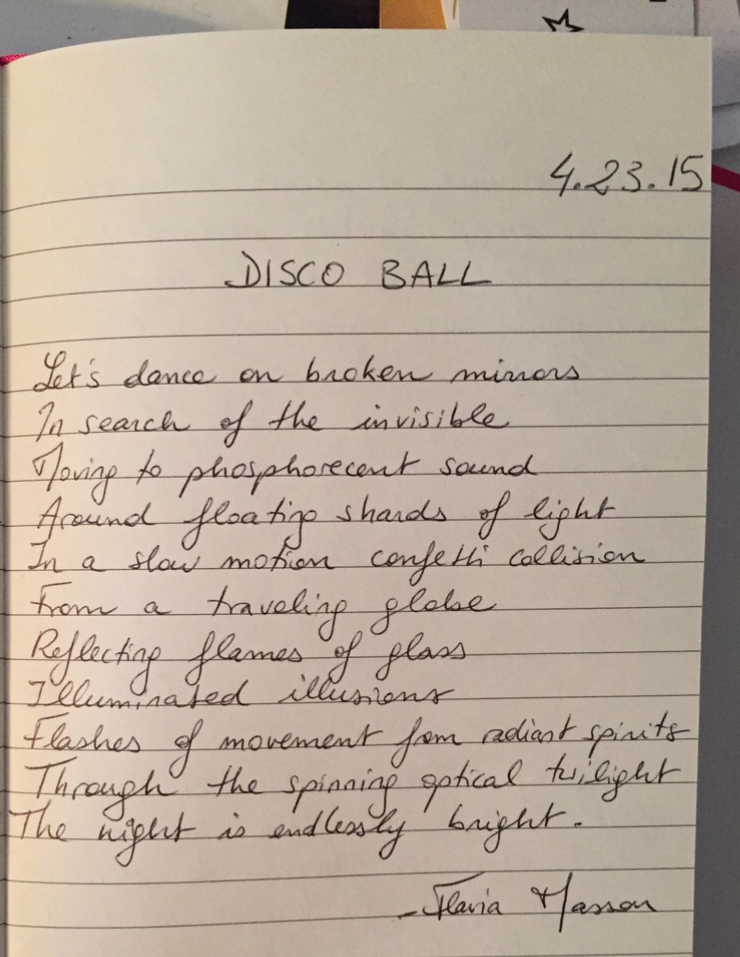
POETIC DISCO

DISCO BALL BY FLAVIA MASSON

DISCO BALL

Let’s dance on broken mirrors

In search of the invisible

Moving to phosphorescent sound

Around floating shards of light

In a slow motion confetti collision

From a traveling globe

Reflecting flames of glass

Illuminated Illusions

Flashes of movement from radiant spirits

Through the spinning optical twilight

The night is endlessly bright.

FLAVIA MASSON